

Last week, we talked about making room to read again: 20 minutes, phone away, one sentence.
This week, I want to make that practice a little richer, but not harder.
If you love vintage books, especially poetry, journaling can be one of the simplest ways to keep what mattered from your reading without turning it into homework. It is not about writing something deep or impressive. It is just a way to notice what stayed with you.
That feels especially right in March.
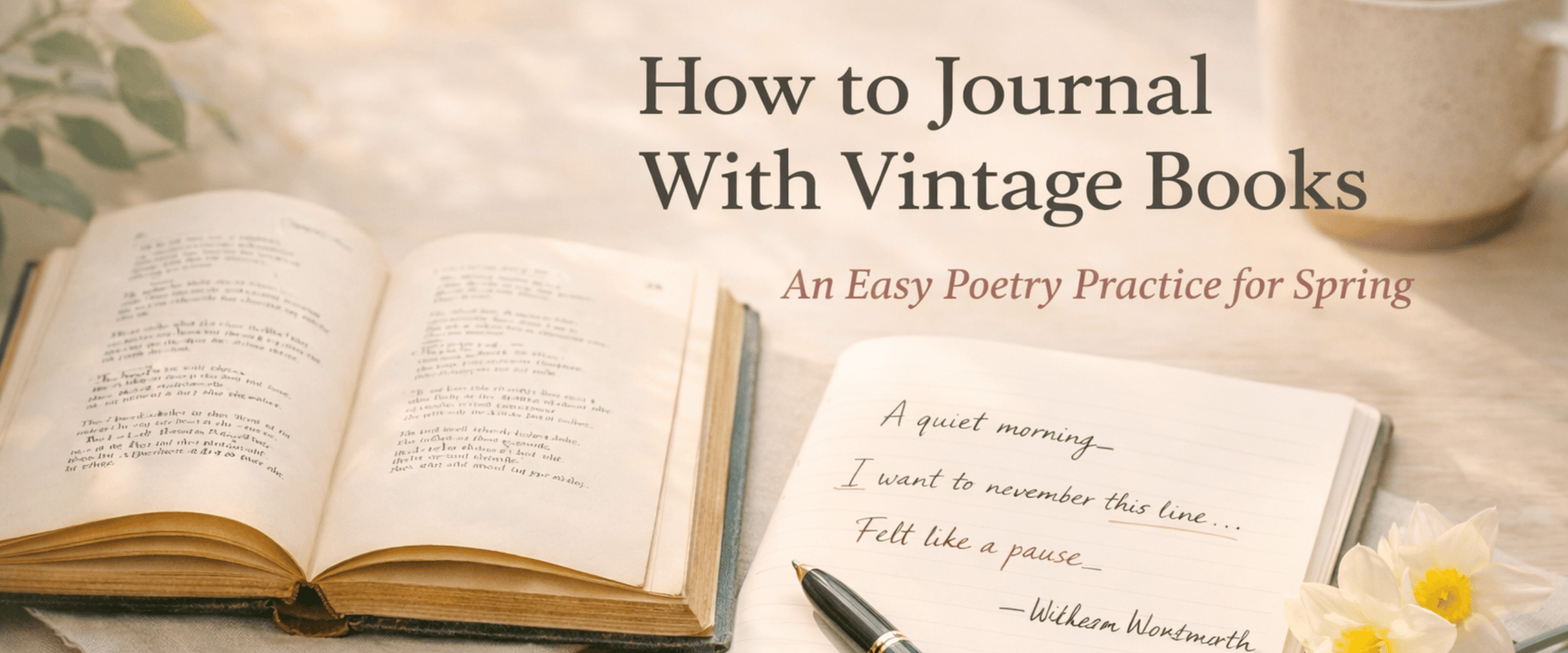
Journaling with vintage books can be as simple as copying one line that stayed with you and adding one honest note beside it. A poetry collection works especially well because you can open it anywhere and still find something worth keeping.
This in-between season has a way of making many of us feel a little restless. Winter is still hanging on, but spring is trying to show itself. It is a good time for small practices that help us pay attention again.
A vintage poetry collection is perfect for that because you do not have to read for long, and you do not have to start at the beginning. You can open the book anywhere and still find something worth keeping.
And sometimes, that is all you need.
More than most people think.
Sometimes journaling means copying down a full quote because it says something you could not quite say yourself.
Sometimes it means saving only a few words because they sounded beautiful, useful, or quietly true.
Sometimes it means writing, “I do not know why this stayed with me, but it did.”
That counts too.
A lot of readers give up on journaling before they really begin because they assume every note has to become a lesson. They think they need a polished response or a meaningful takeaway every time they sit down with a book.
But reading does not always work like that.
Not every passage needs an explanation.
Not every insight needs to become advice.
Sometimes a book simply touches your day for a moment, and your journal is the place where you let that moment stay.

Poetry collections are especially good for this kind of practice because they do not ask for much setup.
You do not need a free afternoon.
You do not need a perfect mood.
You do not need to remember what happened in the last chapter.
You can open a poetry book at random and find a line that meets you exactly where you are, whether that is hopeful, tired, curious, distracted, grateful, or somewhere in between.
That is part of what makes vintage poetry so comforting. It can feel both small and lasting at the same time. A short poem may take only a minute to read, but one line can follow you for the rest of the day.
That is where the journal comes in.
It gives that line somewhere to land.
If journaling has ever felt stiff or school-like, here is a gentler way to think about it.
Journal as if you are the invisible friend beside the text.
Not a critic.
Not a student.
Not someone trying to prove they understood everything.
Just a quiet witness sitting near the page.
An invisible friend might say, “That line felt true.” Or, “I needed that today.” Or, “These words are beautiful, and I do not want to lose them.”
That is enough.
In fact, that is often better than trying to sound smart.
This kind of journaling works because it leaves room for your real response. Your thoughts do not need to be especially developed. They do not need to arrive polished. They only need to be honest enough to mark how the reading met you.
That is what makes the habit sustainable. Not pressure. Not perfection. Just a practice that fits the way real readers actually live.
There is another reason this works so well for vintage book lovers.
Books do not always stay with us forever.
Some get sold. Some get gifted. Some move on to another reader and another shelf.
But the note you wrote, the quote you copied, and the thought you had in that moment can still stay with you. Your journal becomes a kind of companion archive. Not formal. Not precious. Just a place where the reading life continues, even when a particular book does not remain in your hands.
That is one of the quiet gifts of keeping notes from vintage books.
The insight travels with you.

For early spring, I keep coming back to a line from William Wordsworth’s I Wandered Lonely as a Cloud:
“They flash upon that inward eye
Which is the bliss of solitude.”
It feels right for this week because it captures something readers know well: the best parts of reading do not always stay on the page. Sometimes they return later. A line comes back while you are making coffee, folding laundry, or looking out the window. It rises again when you need it.
A journal gives those returning thoughts a place to gather.
This week, keep it simple.
When you find a line or phrase you want to save, copy it down. Then write one short note beside it as the invisible friend.
You might begin with:
One or two sentences is enough.
You are not trying to produce something wise.
You are just making space to notice how what you are reading affects you.
When you want a little help getting started, try one of these:
Open a vintage poetry collection anywhere.
Copy one line, or even just a few words.
Then write this sentence in your journal:
Finish it without editing yourself.
That is all.
No long entry required.
No perfect insight needed.
No pressure to make it into something bigger than it is.
Because sometimes the most lasting part of a book is not the plot or the lesson.
Sometimes it is simply the line that stayed with you, and the quiet note you wrote beside it when it did.
Still wondering where to begin? These quick answers may help.
No. One page, one poem, or one line is enough.
A quote, a few words, or one honest sentence about what stayed with you.
That is fine. Write what it made you notice, feel, or want to keep.
No. A plain notebook, planner page, or scrap paper works well.
Poetry is easy to open anywhere, and even one line can stay with you.
Short is best. One or two sentences is plenty.
Start with one line from your reading, then write: “As the invisible friend beside this text, I notice...”

If you’d like a quiet place to keep the lines and thoughts that stay with you, I made a gentle companion worksheet to go with this week’s practice.
The Quote + Reflection Worksheet includes space to copy a meaningful line, add a short reflection, and use a few gentle prompts when you want a little help getting started.
It is designed to feel simple, calm, and easy to return to—whether you print it out or add it to your tablet notebook.
If this kind of reading helps you slow down and notice more, the worksheet gives you a place to keep those small moments in one spot.
Download the Quote + Reflection Worksheet here.
If you’d like to stay with this practice a little longer, you can browse vintage poetry for a collection to open anywhere, return to Week 1 for the simple 20-minute reading reset, or download the Quote + Reflection Worksheet for an easy place to keep the lines and notes that stay with you.
At Reading Vintage, I love simple note-taking practices that let the insight stay with you even when the book itself moves on.
 Author Bio: Pam of Reading Vintage
Pam is a vintage book seller who turned her passion into Reading Vintage, a online bookstore. She finds old classics, fun collectibles, and hidden literary gems throughout Michigan.
When she’s not exploring estate sales for her next treasure, Pam enjoys walking in the woods with her dog, teaching water aerobics, and curling up with a good read.
Comments will be approved before showing up.

